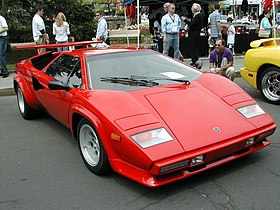
 The Lamborghini Countach , V12 sports auto created by Italian auto producer Lamborghini from 1974 to 1990. Its configuration spearheaded and promoted the wedge-formed, pointedly calculated look well known in some elite games autos. It additionally advanced the "taxicab forward" configuration idea, which pushes the traveler compartment forward to oblige a bigger motor.
In 2004, American auto magazine Sports Car International named the auto number three on the rundown of Top Sports Cars of the 1970s, and recorded it number ten on their rundown of Top Sports Cars of the 1980s.
The Countach was styled by Marcello Gandini of the Bertone outline studio, the same architect and studio that composed the Miura. Gandini was then a youthful, unpracticed architect — not extremely experienced in the useful, ergonomic parts of vehicle outline, however in the meantime unhindered by them. Gandini again delivered another striking outline. The Countach shape was wide and low (1.07 meters or 42.1 inches), however not long (just 4.1 meters or 163 inches). Its precise and wedge-formed body was made totally of level, trapezoidal boards.
The entryways, frequently credited as a Lamborghini trademark, were a wonderful outline highlight for the Countach. They initially showed up on the Alfa Romeo 33 "Carabo" idea auto in 1968, a prior outline achievement, additionally by the gifted Gandini. The entryways have come to be known as scissor entryways: pivoted at the front with level pivots, so they lifted up and tilted advances. The fundamental reason is the auto's tubular spaceframe skeleton brings about high and wide entryway ledges. It was likewise somewhat for style, and mostly in light of the fact that the width of the auto made customary entryways difficult to use in even marginally restricted space. Care should have been taken, however, in opening the entryways with a low rooftop overhead. The auto's poor back perceivability and wide ledges prompted drivers embracing a technique for turning around the auto for stopping by opening the entryway, sitting on the ledge, and switching while looking over the back of the auto from outside.
The unadulterated style of the model was dynamically modified by the advancement of the auto to enhance its execution, taking care of, tractability, and capacity to meet commanded prerequisites. This started with the principal generation model, which incorporated a few vents that Lamborghini discovered important to cool the motor sufficiently. These incorporated the notorious NACA channel on the entryways and back bumpers. The auto plan changes finished with a vast motor vent straightforwardly behind the driver, decreasing the back perspective. Later increments—including bumper flares, spoilers, carburetor spreads, and guards—dynamically changed the auto's stylish qualities.
The Countach's styling and visual impression made it a symbol of extraordinary outline to nearly everybody aside from car engineers. The unrivaled execution qualities of later Lamborghini models, (for example, the Diablo, or the Murciélago) spoke to execution auto drivers and designers, yet they never had the creativity or ludicrousness that gave the Countach its qualification. The diverse impressions left by the different Lamborghini models have produced various level headed discussions and differences over what constitutes "exemplary" or "extraordinary" car outline (exquisite looks and style, versus specialized and designing prevalence). In spite of the difficulty and (required/required) redesigning after some time, one ought to note that the essential famous state of the principal Countach model uncovered in 1971 remained for all intents and purposes unaltered over a particularly long 19-year lifespan.
The Countach utilized a skin of flying machine grade aluminum over a tubular space outline, as in a dashing auto. Albeit costly to manufacture, it is tremendously solid and light; in spite of its size, the auto weighs around 1,400 kg (3,100 lb).[7] The underbody plate was fiberglass.
Post a Comment